
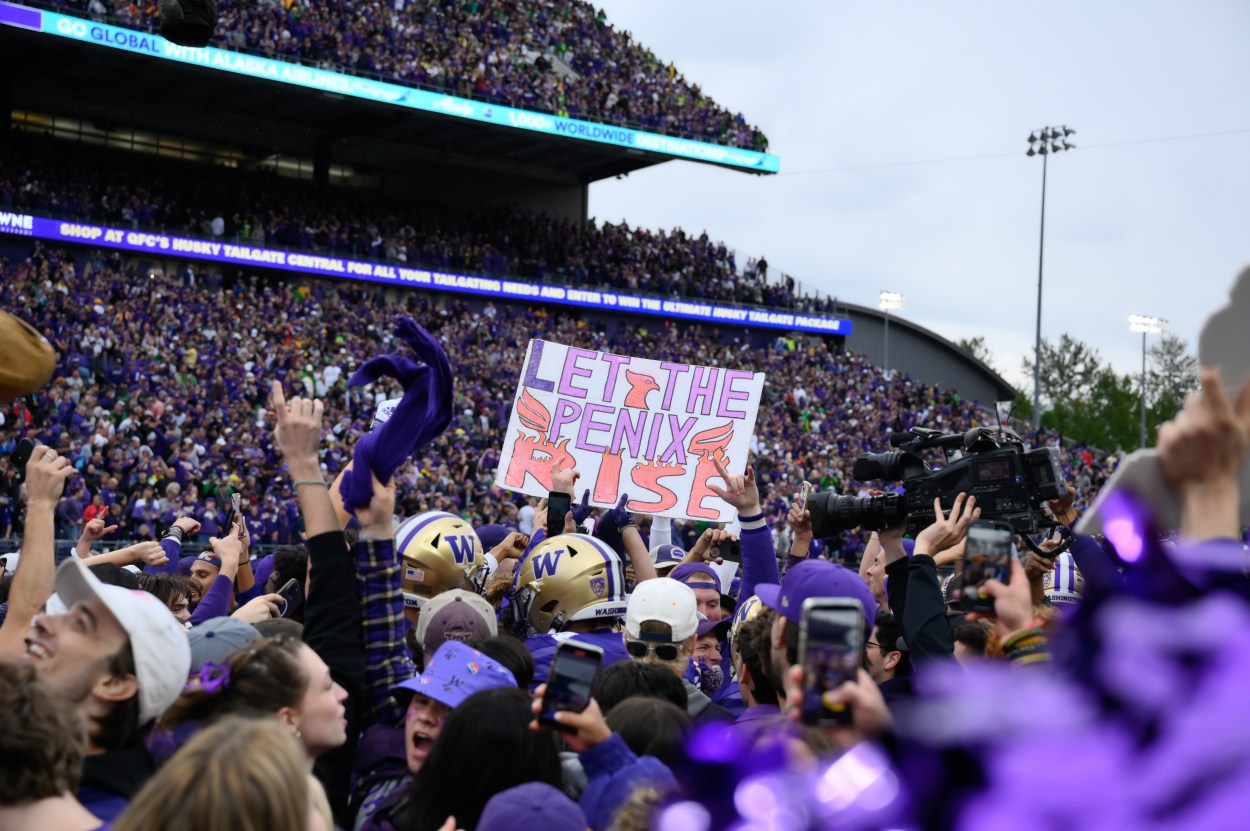
Saturday brought the biggest win in at least a decade for the Washington Huskies football program. It was a delirious football game between two teams at or near their peaks, with Heisman contenders at quarterback and future NFL players at nearly every position on both teams.
The atmosphere was raucous, from a College GameDay taping at 6am with the lights of the set outpacing the sunrise all the way until the final kick, a miss from Oregon’s Camden Lewis that let loose a tidal wave of emotion and humanity as the Huskies fans rushed the field. Students lined up through the night and a light dusting of rain to get on set of GameDay. The harbor was full of sailgating boats; the parking lot packed to the brim with tailgaters. The press box quite literally shook as the crowd willed Washington on.
When the dust settled, the prevailing reaction from national pundits was that this was one of the best atmospheres in the sport. Many of them had experienced it for the first time with every eyeball in the country turned towards Montlake. The Huskies added an ancillary row of press box seats to fit what felt like college football’s World’s Fair into the stadium.
This was many people’s introduction to what’s been self-titled the Greatest Setting in College Football. And that’s beautiful; the fact that it lived up to that claim on Saturday is not something that should be lost. But if you’ve been paying attention, you would’ve known Washington has deserved that title, and this coverage, and this respect, for much, much longer.
I’m biased, of course. I went to Washington, one of thousands of California transplants to move north thinking they’re passing through town only to end up ensnared by the Pacific Northwest. My freshman season was the playoff year, marked by what felt like a program defining win over #12 Stanford in late September and marred by a loss to USC in miserable weather the last time ESPN brought their studio crew to campus.
That year, I was one of the students who camped out all night in the rain to get on set for GameDay, taped in the pitch dark in the slipperiest part of campus. We got in line at 3am after staying up all night making signs and were met by a couple thousand people who had done the same.
I was also in the student section a few weeks prior for the Stanford game, a 44-6 bludgeoning of a Christian McCaffrey-led powerhouse. And when the stands emptied so we could celebrate on the field with the team, my California-bred friends and I hesitated. Surely, we thought, there would be better opportunities to storm the field than this. We were the higher ranked team, favored to win, and had blown them out. Short term, USC was coming to town in five weeks. And so we deferred, watching the celebrations from the bleachers.
I will regret that for the rest of my life. Because I learned rather quickly that we weren’t quite familiar with Washington as a program. There wouldn’t be another opportunity to jump the barrier until Saturday, three years after I got my diploma.

See, Washington has played football since 1889, the same year as Ohio State. Only 20 schools have played the sport longer than the Huskies. They have the second longest winning streak in FBS history, a 40 game stretch from 1908-1914. The Greatest Setting was built in 1920. They’re the 23rd-winningest program of all time, 18th when you limit it to teams who have played at least 1,000 games. Since Warren Moon in 1976, almost every starting quarterback has played in the NFL.
And yet, Washington isn’t seen as a blue-blood football program the same way other teams with histories like theirs are. Florida, Miami, Auburn, all only a few ticks above the Huskies in all-time win percentage. Second tier schools like Texas A&M and Michigan State, a few ticks below. Yes, the mid-2000s under Keith Gilbertson, Tyrone Willingham, and Steve Sarkisian were dismal. But programs that have gone through similar stretches – Nebraska and Tennessee for instance – are still regarded as bastions of the sport who will climb out of the doldrums.
But when Washington did just that under Chris Petersen, culminating in that 2016 run, there was little mention of history. There wasn’t much fanfare about how great it was to see one of the country’s power programs back on top. No, instead there was the Quint Kessenich cupcake segment. There was ire at the Huskies making the playoff as a one loss conference champion, followed by ridicule when they got the doors blown off by a juggernaut Alabama team. Eight months ago The Athletic cut the Washington beat prior to the season, forcing top tier beat writer Christian Caple to Substack.

All of that negative press then was for the same reasons as for all the positive press now: nationally, people don’t know UW football has always been this way.
The crowd has always been this way – the loudest crowd in NCAA history was on Montlake in 1992 – and it’s not even that difficult of a leap to figure out why. Watch a Seahawks game. Watch a Kraken game. Hell, watch a Mariners game or a Sounders game. People in Seattle live and die by the outcomes of their local teams in a way that fits the stereotypes of those east of the Mississippi, not the aloof Californians to the south. I know this for a fact, because I grew up close enough to USC to feel the aftershocks from LA-centered earthquakes. I was in elementary school when Matt Leinart and Reggie Bush were taking the Trojans to the national championship, bringing another Western power back to the top of the sport.
Hardly anybody cared near me. We mentioned it, sure, and I was dialed in, but it wasn’t the same as it is here. Watch a Rams game or a Chargers game and you can see that same sort of attitude. There’s a subset of people who care incredibly deeply – I cover the Chargers now, so I know this for a fact – but it simply does not consume an entire city the way it does in Seattle.
The setting has always been this way. They built Husky Stadium on the grounds it’s still on one hundred and three years ago. It’s been renovated three times but never moved, so it’s not like people are just learning about the environment because they just moved there. The rivalry with Oregon has always been this way. They’ve played one another nearly every season since 1900 and have met only four fewer times than Michigan and Ohio State.
Everything about this program has always been this way. I’m not mad at you, and I don’t think anybody in Seattle would be either, for not knowing this. I had to learn all this, too, in the shadow of my decision to not rush the field against Stanford in 2016. But my point is that Washington is a blue-blood. They just play on the West Coast in a city that’s not Los Angeles. They’re a self-contained fanbase that doesn’t pervade the national landscape because most people that end up in the Pacific Northwest never leave and plant those seeds elsewhere. Instead, the people that show up bring their own seeds and plant them here, adding to but never changing the menagerie of greenery framing the mountain views.
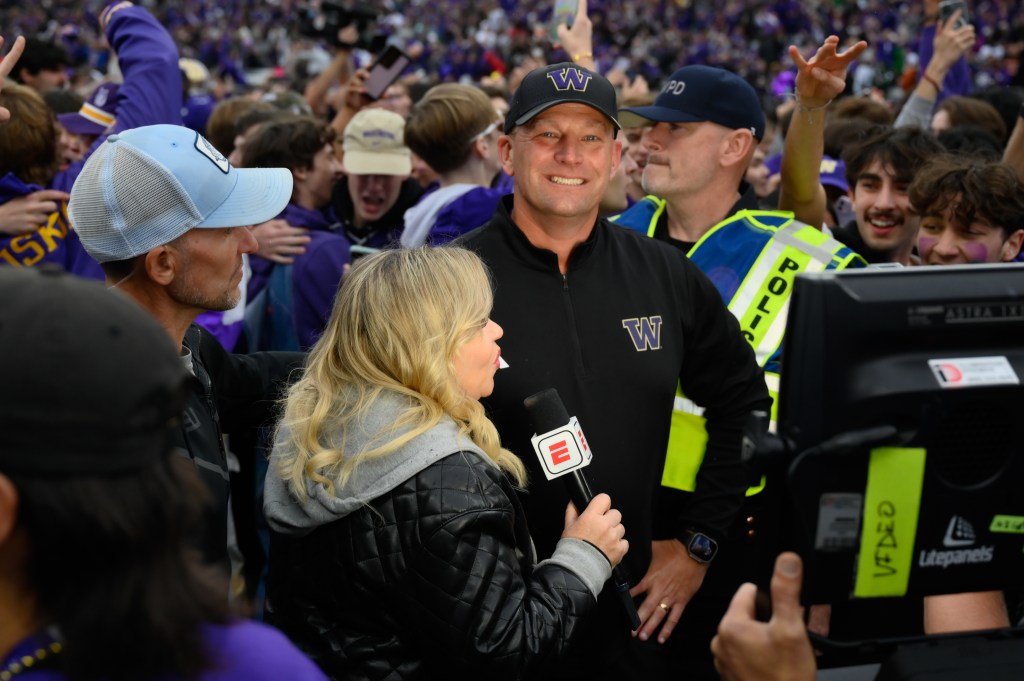
Just look at the authors of Saturday’s win for proof of this. Kalen DeBoer is a South Dakotan, not quite an aw shucks Midwesterner but certainly a humble one, who hasn’t let the spotlight of his job change him. Twelve of his Sioux Falls players came to Seattle to watch the Huskies on Saturday, invited personally by DeBoer. His daughter is committed to play softball for Washington starting this season. He’s shot down every rumor of his eyes wandering elsewhere, even in the wake of the departure of athletic director Jen Cohen. (I know every coach does that, but read anything about DeBoer, and it’s clear he will have no interest in leaving as long as his daughter is on campus.)
The avatar of DeBoer’s offensive revolution is, of course, quarterback Michael Penix Jr. A Florida native who began at Indiana, Penix’s career was threatened by two ACL tears to the same knee and major injuries to both shoulders. He came to Washington last season to reunite with DeBoer, his former offensive coordinator at Indiana, and exploded back onto the national radar. He could’ve left for the NFL last season. So could’ve Rome Odunze or Jalen McMillan or Bralen Trice or Zion Tupuola-Fetui. They all had their reasons for coming back. For Penix, it’s always been as simple as gratitude. Gratitude for being able to still play after all those injuries, for DeBoer taking another shot on him, for the way the fanbase rallied around him in a hyperexciting 2022 season. It’s not hard to see what Washington has come to mean to its biggest star: Penix teared up on Saturday as the fight song played during his postgame interview after he fought through severe cramps for most of the fourth quarter. He collapsed into his family’s arms among the massive celebration around him, the moment washing over him as the city declared him a legend on the spot. He’s now the favorite to become Washington’s first Heisman winner in program history, one of the lone trophies yet to be set on the Huskies’ collective mantle.

Modern college football, at least its establishment, has a funny way of making sure you believe that only a certain upper crust of teams matter. It just means more in the SEC. The Big Ten are the arbiters of tradition. Everything else is a novelty, a rat race for your fleeting attention on a Saturday as you flip through channels.
The massive crowd and electric atmosphere and sailgating didn’t spawn in because ESPN decided to point a camera at them for the first time in seven seasons. ESPN and The Athletic and FOX and whoever else might think that, I don’t know. What I do know is that three weeks before this, Husky Stadium was almost as jacked up to watch Washington play Cal. This coming Saturday, they’ll almost certainly be almost as jacked up to play Arizona State.
The rest of the country’s eyes will wander, as they always do. Washington will move to the Big Ten to up their reputation and maybe that will finally be what the program needs to be recognized like this on a week-to-week, year-to-year basis. The departures of Penix and most of his co-stars will leave those in national studios questioning, the same way they did after Jake Browning, John Ross, Dante Pettis, and Myles Gaskin graduated to the pros. It’s impossible to know what the future holds.
Except for one thing: UW football will be this way.
 neptunescouting.com